Monday, September 29, 2014

Whales, Wallabies, and Cockatoos


It is so hard to get a good picture of a whale.  The delay between when you press the button and when the picture actually takes is enough that the whale has already gone under.  We have seen quite a few whales.  We are careful not to get too close and make them feel harassed but they have come close to the boat on their own.


Cockatoos are around here like pigeons are in the US.  We see them alot and hear them more than that.  They are loud squawkers.  One afternoon we heard noise outside and came out to find a cockatoo walking around the boat.  We gave him some peanuts which he devoured.  He flew away when they were gone but came back an hour later for more.   This time he got a cracker but left a crumby mess.  I think he liked the peanuts better.


At Geoffrey Bay, Magnetic Island, there are Rock Wallabies living in, guess where? (the rocks).  They are like small Kangaroos.  About the size of racoons.  Like many of the other animals here, they don't seem to be too worried about people.   We brought some carrots to them which seemed to be a big hit.  They gently take the carrot and slowly eat it.  There were mum wallabies that had baby joey's in their pouches.  This place is like being at the zoo, without the zoo.


Thursday, September 11, 2014

Let's Shag, baby


 Pirate-front lores
There is a small island 20 miles north of the Whitsundays that acquired the name of SHAG ISLAND.  A group of cruisers founded the Shag Island Cruisers Yacht Club (sicyc.com.au).  The name has evolved to 'Shaggers' and has members from all over the world.  Every member is a Vice-Commodore and is responsible for a specific geographic area that they are knowledgeable about briefing others that may be cruising there.  We are now members and my location is Harvey Cedars, New Jersey, of course.  There is an annual Shaggers Rendezvous at Shag Island and Monte's Resort on Gloucester Point.
 
There are quite a few business sponsors of Shagges and they give nice discounts. 
We arrived Friday afternoon and anchored with about 200 other boats.  We didn't get a close parking spot so the dinghy ride was quite far.  We did Friday Happy Hour with a band that played on the beach.  Saturday had plenty of events and a concert by a Jimmy Buffett cover band.  The Rendezvous is not just a drunk-fest but actually raises money for the Australian Prostate Cancer Foundation.  This year they raised almost $200,000.
So, we met old friends and made new ones.  We left on Sunday, made the 20 mile sail back to the Whitsundays and picked up a mooring ball in Butterfly Bay on Hook Island.

Sunday, September 7, 2014

Cid Harbor, Whitsunday Island

There were a few days of rough weather coming in so we went up a nice creek for some calm.  They call them Inlets but the US definition of an inlet is different.  It's really not a creek either because there is no water flowing out.  Just tidal flow.

View from Whitsunday Peak
Gulnare Inlet was very peaceful and we had no idea how hard the wind was whooping outside.  This anchorage is rarely used because the entrance depth is 1 foot at low tide.  We need 4 feet or we'll hit bottom.  But with a 10' tide and good timing you can go in and you're in an inland lake at low tide with no way out.  At least until the next high tide.


We left after 2 days for Cid Harbor.  It's really not a harbor but a big protected anchorage.  The US fleet hid in there during WWII.


We made the 5K hike to Whitsunday Peak and it was worth the aches we had the next day.
Gulnare Inlet where we 'were' anchored for 3 days


Thursday, September 4, 2014

Aussies Love Camping


One thing that we have seen everywhere we go is that Aussies love to camp.  Whether it is in a tent pitched on the beaches we pass while sailing, or in beachfront RV parks in just about every town.  There are huge migrations of 'Caravans' (RV's) heading up the Queensland Motorways this time of year similar to the US West Coasters heading up to Alaska for the summer.  

Green Areas are Parks

The Australian National Park System make the US National Parks look miniscule.  They have parks everywhere.  Town parks, roadside parks, beachfront parks, big, small, complete islands, even a reef and surrounding islands, (The Great Barrier Reef National Park).  Camping seems to be promoted everywhere by businesses and the government and is hugely cultural.

Up until now, we have never met cruisers that carry tents on their boats.  Now we have.  They have cook stoves, shovels, dutch ovens, griddles, fire pokers, and of course the tents.  A beach to an Aussie is just another place to set up camp.  If you can't get there in a 4 wheel drive, take the boat.  We've seen heaps (there's that Aussie word again) of small aluminum boats, they call'em 'Tinnies', pulled up on the beaches with tents pitched on the dunes.

So we pull in to the anchorage at Thomas Island and just because there is a sign on the beach that says 'No Fires", no worries!  We're not just talking about a campfire that you sit around and tell stories.  We're talking about building a campfire in the afternoon, doing Happy Hour, cooking dinner on it, and drinking and talking for hours.


We had so much fun and haven't smelled of smoke that much since doing a weekend of Boy Scout camping.  Dinner and conversation around an open fire has such a great feel to it.  There was still firewood left so we stayed another night just to do it all again. 

I think the Aussies really have it figured out.

Friday, August 22, 2014

Back in Cruising Mode


We're back in the cruising mode.  Now that we have reached the Whitsunday Islands, there is alot, (or 'heaps' as the Aussies say) more time to meet people and stay around when the fun is to be had.  The Mackay Marina sponsored a Parking Lot Barbeque for all the guests that could make it.. 

We met up with our South African friends, Rowland and Miki, that we haven't seen since GCCM.  We met quite a few new cruisers that were waiting out the weather also.  Tim and Karen on the Hunter 45, DA LUKE.  John and Soraya on the Hylas 45, MERLIN.  Anne and Alan on SAGITAIRE, Evan, Diane, and Maia on CEILYDH.  Mike and Heather on GEORGIA, and John and Chris on UKELELE.  We crossed paths a few times over the next few days as we island hopped north.  An island will have good and bad anchorages depending on the wind and swell so we ended up at the most logical anchorages together.

We first went to Brampton Island.  We went ashore and explored the deserted Brampton Island Resort.  It looked as if it was operating one day and then everyone just disappeared.  Pool tables with balls and cues, beach furniture stacked for the night.  Jetskis and Hobies were waiting for the next days guests who never came.  The place has been abandoned for probably 3-4 years.  Kind of creepy.

Brampton Island Resort

Ready to play pool

Just needs a little landscaping

Still in pretty good shape

Even a deserted runway


Everyone in the anchorage got together for sundowners and we used their nice dock as our party patio.  It was nice to reunite with the Mackay folks and meet new people.
The Sundowner Crew

At least we're back to barefeet


The anchorage seemed great but turned rolley as the night wore on.  One of those wind, current, swell switching around nights.

Thursday, August 21, 2014

Tides, Current, and Anchoring.


Mackay is within easy striking range of the Whitsundays.  There are islands as far as you can see.  We have even been referring to this area as the AVI's (Australian Virgin Islands) because they are so similar to the British Virgin Islands, only so many more islands covering so much more area.  Whale sightings are now almost as common as dolphins and we are still 30 miles inside the Great Barrier Reef.

Even though the Barrier Reef is blocking much of the Pacific Ocean swell, in many of the anchorages the boats get rolling and uncomfortable at times.  The real issue however are the tides.  They are huge at 23ft in Mackay and 18 ft in the Whitsundays.  The hydrodynamics of this area are similar to the Chesapeake Bay with the Barrier Reef being similar to the Eastern Shore with similar depths.  However, the Chesapeake has 2 ft tides and still has some pretty good current.  Imagine what a 23 ft tide would do with the volume of water in the Chesapeake.


So even when anchoring at an isolated island, there is current as if you are in a coastal river and the boat will swing 4 times daily according to the tide and not according to the wind.  Since you are not pointing in to the wind but covering 180 degrees of swing, there are times when the ocean swell, wind chop, or current counter wind will be hitting the side of the boat and there you go, rocking and rolling.

Normally we put out an anchor chain length of about 4-5 times the depth of the water.  This is called 'scope' and make a low angle at the shank of the anchor which keeps the anchor from pulling out.  With these big tides, you have to check your depth and tide when picking a spot to anchor to make sure that you won't be sitting on the bottom when the tide goes out.  You also need to add the tide to your depth so you have scope to keep from pulling your anchor out when the tide goes high. 

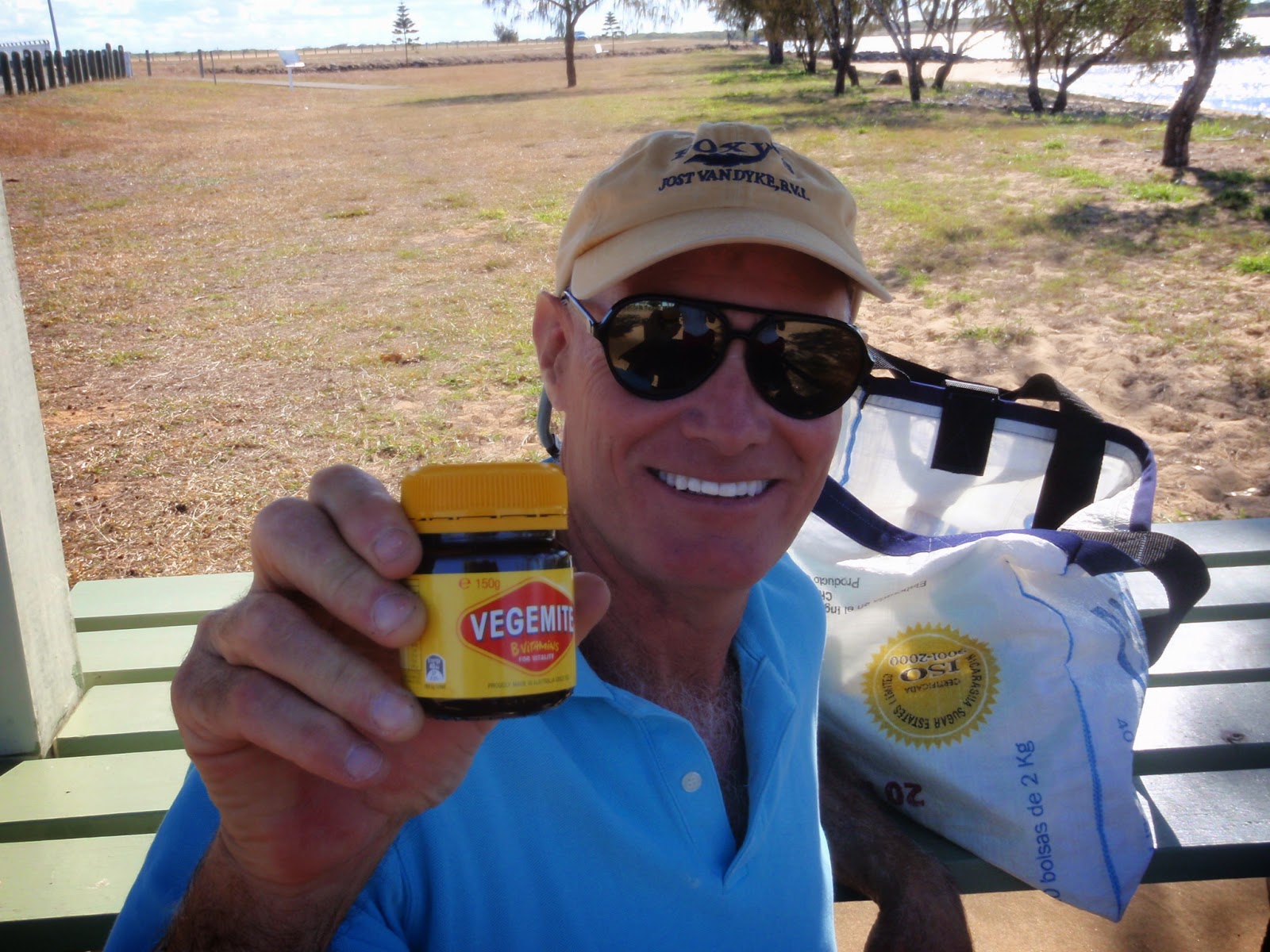
Anyone for a Vegemite Sandwich


'Up Island'

Small Boat 'Dry' Marina in Manly

In the Caribbean you travel 'Down Island' to get to warmer latitudes.   Since we're Down Under, we're going the other way, 'Up Island'


It took us one month to travel from the Gold Coast City Marina to Whitsunday Islands.  Three of those weeks were spent in marinas.  When we left, the temperatures at night were in the 40's so being able to plug in to shore power is a real plus.  There were fronts and weather to avoid and the marinas were snug along a coast that exposed to the full force of the Pacific Ocean.

Australian marinas are expensive ($79-$80 per night) and they charge 50% more if you have a catamaran.  The weekly rates, however, were the same as 5-6 nights so as long as we were waiting out 4 days of weather, well, you might as well stay for the week.

Our marina stays were as follows:
    Manly - 2 nights (Thunderstorms)
    Mooloolaba - 7 nights (4 days of high wind)
    Hervey Bay - 1 night (positioning for early 3AM departure)
    Bundaberg - 7 nights (5 days of high wind)
    Mackay - 7 nights (5 days of high wind and rain)

The beach at Mooloolaba


We anchored only 3 times:
    Garrys in Sandy Straits - 1 night - calm
    Pancake Creek - 1 night - well protected
    Great Keppel Island - 1 night - couple hours of rolling

We covered about 500 nautical miles, the weather warmed up as we came north and now anchoring is the method of choice and you can't beat the economics, free.