Thursday, December 7, 2023

Parallel or Series


https://sailtortuguita.blogspot.com/2023/12/parallel-or-series.html

For a small battery bank, like 100 Amp hours (Ah), you can put four 3.2 volt, 100 Ah cells together in series to get a 12 volt 100Ah bank like shown below.  If you need more capacity, you can put another bank in parallel with the first to give 12 volt 200Ah.

4S2P with multiple Daly BMS
There are a couple of problems with this type of arrangement.  Each 100Ah bank needs its own BMS so 5 banks need 5 BMS's.  That gets expensive but does provide some level of redundancy.  If one bank goes bad or a BMS fails, you can always pull the bad section out and you still have a workable system.

These type of BMS's use FET transistors to shut off charging or discharging protecting the cells.  In theory, if all 5 banks are perfectly equal, each bank will share the load with every other.  If for example, your fridge draws 20 amps, each bank would provide 4 amps.  Like any DC system in parallel, like alternators, batteries, or solar panels, there are small differences and imbalances occur.

So you may even have all 20 amps being provided from one bank with the others providing nothing.  That's worst case but they never balance out.

There is not a BMS that exists that would solve this problem but one could be made if it had network communication between and PWM output from each and every BMS so that they can all coordinate and output the same power.  Unfortunately nobody make such a thing.

The FET transistor switches of these small BMS's, like any transistor, have maximum power ratings and are destroyed by heat.  I do not think it is prudent to trust the health of your boat's electrics to a possibly under-rated cheap Chinese transistor.  Unbalance between the BMS outputs may very well cause a single FET maximum current rating to be exceeded sooner than expected.

An example I saw was that a friend had his banks 'either/or'.  One bank would put out all the power until it's voltage was low enough that it would then be taken over by the other bank which would then put out all the power.  This would go back and forth until they needed to be recharged.  Rinse, repeat.

I would think what happens on the charging mode is similar except, if a cheap Chinese FET fails to cut off the charging source, that's when you could get a fire.

One last thing that I have seen with series is that one battery acts as a charging source for the other. The power goes back and forth between the parallel banks and some capacity gets lost as heat to the balance shunts.  So if you let these sit for extended periods, you could come back to your boat with discharged batteries.

We installed a 12 volt, 1000 Ah system made up of 40 3.2v 100Ah cells.  To do this as a series first parallel second system would need 10 BMS's at $150 each and have all the problems described above.  The nomenclature for this would be 4S10P.  That means 4 in series first and 10 of those in parallel second.

 So, what to do?  Go with Parallel first and Series second.  That would be 10P4S.

These are our 40 cells as 10P4S
With this configuration, you hook 10 cells together in parallel giving 3.2v 1000 Ah and then connect 4 of those groups in series which brings the voltage up to 12 volts.  A big advantage of this design is that it only requires one BMS.

The good thing with Parallel first is that all the parallel cells stay balanced, they have to stay balanced because they are all connected together.  Then you only have 4 series banks that need to be balanced by the BMS.  

So, the BMS is connected to each 3.2v 1000 Ah bank.  Each of these banks are kept in balance by the BMS which reads the individual bank voltages and trips the appropriate relay for charge or discharge protection. 

Since the BMS needs a very good way to shut off charging and discharging, FET transistors are a very bad choice.  Relays are a much better and reliable choice.  They can handle much more power and can be manually switched in an emergency.  I chose the Blue Sea ML-RBS 7700.  They can handle 500 Amps continuously and will handle 300 Amps while switching.  I will never be able to supply or discharge that much current on our boat.


Tuesday, November 21, 2023

The Balancing Act

 https://sailtortuguita.blogspot.com/2023/11/the-balancing-act.html

It's fairly easy to read the battery voltage.  It is your system voltage.  It can be measured just about anywhere wires run for your 12 (or 24) volt system.

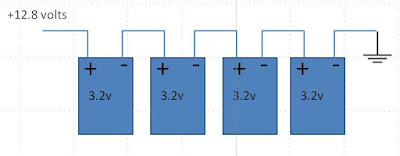
The battery bank on the right is a typical 12 volt Lithium parallel cell arrangement.  Each cell contributes 3.2 volts for a total system voltage of 12.8 volts.

This is assuming that all the cells stay at the exact same charge state ie: voltage. 

If the charger is set to shut off at 12.8 volts (full charge) and one cell is unbalanced at .2 volts below the others, then the 3 good cells would reach 3.25 volts each and the low cell would be 3.05.  That's will put the good cells further into the Knee.

However, if an unbalanced cell is .2 volts above the others, then that cell would be at 3.35 volts when the bank is fully charged to 12.8 volts while the others have only reached 3.15 volts.

Shunting Transistors for Balancing
In this case, the 3.35 volt cell will probably enter thermal runaway.

So not only must a BMS be able to monitor the voltage of each cell and shut off charging when any cell exceeds a certain voltage but it must be able to take some voltage from a high cell and put it into the others.  This balancing can be either Passive or Active.   

Passive balancing is accomplished with transistor controlled shunts which dissipate higher voltage cells into resistors.  

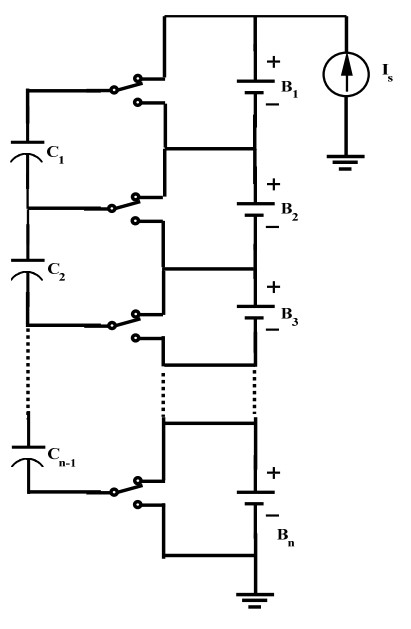
In an Active system the BMS switches transistors which redistribute energy in the out of range cell into a capacitor which then is switched into one of the lower voltage cells.


There are 2 types of BMS's.  Distributed and Centralized. 


Emus Distributed BMS
Centralized BMS's have wires that run to the cells and the sensors are internal to the BMS itself.  Generally, this type of BMS will not have temperature sensors for each cell but one or two bank temp sensors.


Distributed BMS's have their sensors mounted out on the cells in the bank and a network connects the sensors to the BMS 'the brain'.  The Distributed cell sensors will sense both voltage and temperature

I thought a Distributed system was silly since the distance between the cells and BMS were so short it didn't seem justified for all the complexity involved.

I started out thinking the Chargery BMS was a good way to go.  It was a low priced centralized system that included a display and charger.

I bought one and still have it sitting on the boat because I decided not to use it due to it's overly complex setup options.  It also appears to have passive balancing.  It would be easy to drain your system with a minor settings mistake and having the passive balancer shunt your cells down to zero.

I ended up choosing the REC Active BMS for our installation.  It is a very robust, weatherproof, BMS geared toward marine installations vs. Electric Cars.  It is fully CANBus compatible and plays friendly with Victron hardware and displays.  The biggest downside is terrible customer support.  I will have more on the REC in future posts.


Wednesday, October 4, 2023

BMS and the Knees

BMS stands for Battery Management System.  It provides two things, Protection and Balancing.  If it doesn't do those two things, you don't want it.

Lead batteries have a linear charge/discharge profile. The percentage of charge is directly related to the voltage.  12.8 volts is fully charged, 12 volts is 50% and 10 volts is pretty much dead.

The Lithium profile is quite different.  You could be 90% charged at 13.3 volts and have 20% remaining at 13.1 volts. 

Because of such a narrow voltage range, we can't use voltage tell the charge of a Lithium battery.  A device needs to keep track of how much power goes in and out and use that as the State of Charge (SOC).

The big problems happen where the curve goes from basically flat and around the corners (The Knees) during the final stages of charge or discharge.  At the Knees, a little bit of charge goes a long way with regards to the voltage.  

The battery could be charging nicely at 13.3 volts and be 90% charged, It could have even taken all day to get from 13.1 volts (20% SOC) to this point.  Then in a matter of minutes the voltage could go to 14 volts and Thermal Runaway a few minutes later. 

The BMS is what provides protection at the Knees.  A good BMS is imperative in any installation.


Thursday, September 28, 2023

Lithium Battery Conversion

Our Lead-acid batteries were pretty anemic from the day we got them.  After 2 years of sitting uncharged during Covid, they were essentially scrap.  The plan had always been to install Lithium batteries on the next replacement cycle, which is now. 

In the beginning, Lithium seemed buggy and I didn't want to be an early adopter of a completely new technology and be stuck without electricity in far remote locations.  

There always seems to be a new and better technology just around the corner but how long do you wait?  LiFePO4 batteries have been in use for 20 years.  With all the advances and a huge amount of data from installed units, I felt the time had come to take the plunge.     

Prices have come down so much that the batteries themselves are now less expensive than Lead.  An expensive part of the conversion is the new infrastructure needed to manage the batteries.  This includes new wiring, Battery Management, Displays, and Charging.  The initial investment in infrastructure will always be of use in any future battery installation on the boat.

When starting this project, I was warned about how much misinformation was floating around the internet.  There sure was, and still is.  My best go-to resource was the Nordkyn Engineering series of articles.  Soggy Paws has also done a nice how-to with top notch information.

There are numerous advantages to Lithium over Lead-acid batteries and that is uncontroversial so I will let you search for things like weight, capacity, ampacity, and longevity on your own.

A big question that always comes up is "what about fires". 

Lithium batteries have a history of fires but those batteries, like the ones in cellphones and e-bikes, are Lithium Ion, not Lithium Iron.  LiFePO4 batteries and related chemistries have an extremely good safety record if installed and maintained correctly.  

It is important to understand that a good Lithium system is just just Plug-n-Play.  However, there are many bad Plug-n-Play installations out there that are giving Lithium a bad reputation.

Below is a dramatic video showing Thermal Runaway of a GBS 12V 240Ah bank that was initially managed with an Orion BMS.  This event happened one night back in March just in our boatyard in Malaysia.  Fortunately they got the battery off the boat before any damage was done.

In the video, there is only one cell that went into Thermal Runaway.  This was from a charging overvoltage, an electrical issue.   However, it would have spread thermally to the other three cells if the bank had not been separated.  

A Lithium Battery fire is essentially a chemical fire that requires no oxygen to burn and therefore can not be smothered.  Normal fire extinguishers won't work since they attempt to remove oxygen from the combustion and that's not what's going on here.  I think the best way to deal with a fire like this is to throw it overboard to get it cooled down.

The design of this system was solid but the owner really didn't understand the limitations of Battery Management and Cell Balancing.  He treated it like a regular battery and tried to charge it with a car charger.  That did not turn out well.

I have helped quite a few cruisers with their Lithium installations along with getting tours of existing systems.  I tried to take the best of everything when doing my design.  The next group of posts will hopefully put the practical and theory together for those following the more challenging path of a Lithium Battery conversion.


Sunday, September 11, 2022

Feedburner Replacement


No, Feedburner is not a part of the boat.

Easy to Subscribe
I use Google Blogger for this blog.  Mostly because I feel Google gives me better search coverage and it's more user friendly for the reader than Wordpress.

For email subscriptions, I used Feedburner, also by Google.  When someone subscribes to the blog, Feedburner sends an email of the post automatically, not me.  Feedburner was built-in to Blogger so it was easy for me as a beginner.

2 years ago Google decided to stop supporting Feedburner and not allow new email subscriptions but would continue to send emails to people already subscribed.

Easy to unsubscribe
Well, I am finally getting around to finding a new feed service and have decided on "follow.it".

"follow.it" is free, simple to add the code to the blog, and allows me to import subscribers from Feedburner.  Does it work?  The last post was my test and it seemed to go well.

So, if you are now getting 2 different emailings of the blog, not to worry.  I will be clearing out Feedburner and going full on with follow.it.

If you find yourself visiting the blog often, make your life easier and subscribe.  You can unsubscribe anytime. 😀


Tuesday, May 10, 2022

Doha, Qatar

Continual urban renewal

Our flight to Philly from Kuala Lumpur had a 7 hour layover in Doha so we decided to make it a 3 day layover instead and explore a new place.

Hotter than Malaysia but no humidity

Qatar Central Bank, new pavers of course
We have never been to any Persian Gulf country so we thought why not.  We did however have to get a few extra Covid tests. 

The country is built with oil money.  It was nothing more than a sand dune until the early 1970's.  Everything is new since.  It is the 2nd safest city in the world.

The  FIFA World Cup is being hosted in Doha in November 2022.  They have gone all out sprucing up the city.  It looks like every street is being torn up and repaved with granite paver stones.

The giant thumb.  A good reference point

You can get lost easily
We did alot of walking around avoiding the maze of detours, cars, and piles of pavers.

The neatest place we went was the Souq Waqif marketplace.  It's a couple hundred year old Bedouin market that burned down in 2003.   It was rebuilt from 2006-2008 and is really quite impressive.

It is about 20 acres and easy to get lost inside all the alleys, nooks, and passageways.  You can get just about anything there from rabbits to falcons or spices to gold.

It seemed like 90 percent of the population was Indian.  Most had emigrated for the work and education.  The restaurants were good and we ate Indian food every meal except for one Lebanese dinner.  

It was a fun 3 days but we see no reason to do it again.  There are plenty of other layover cities to explore.


Neat primitive architecture


Tuesday, May 3, 2022

The Rest of the Work

The poor little car wasn't meant to haul this much
Unfortunately I didn't take many photos alot the work we did.  

We started out re-bedding the stainless bits that were removed for the spray job.  Wind generator masts, support bracing, life raft canister frames, life lines, bilge pump housings, vent covers, blocks, and clutches all had to be caulked and screwed securely. 

We installed the swim platform (previous post) and hull rubrails.  

The hulls had been sanded just after spraying the gelcoat with 120 grit.  We had to now finish the sanding bot outboard hulls with 400 then 800 grit before installing the rubrails.

We had a machine shop completely redo the swim platform ladders.

Weighing in at the scrap recycler

We got rid of the dead house batteries.  660 pounds of lead went to recycler in Sitiawan.  I got $200 US in exchange.  The original cost was $3800 and they never were any good from day one.  

We ordered 1000Ah of Lithium Batteries from China that will be installed when we get back.  They weigh half as much and have double the capacity.

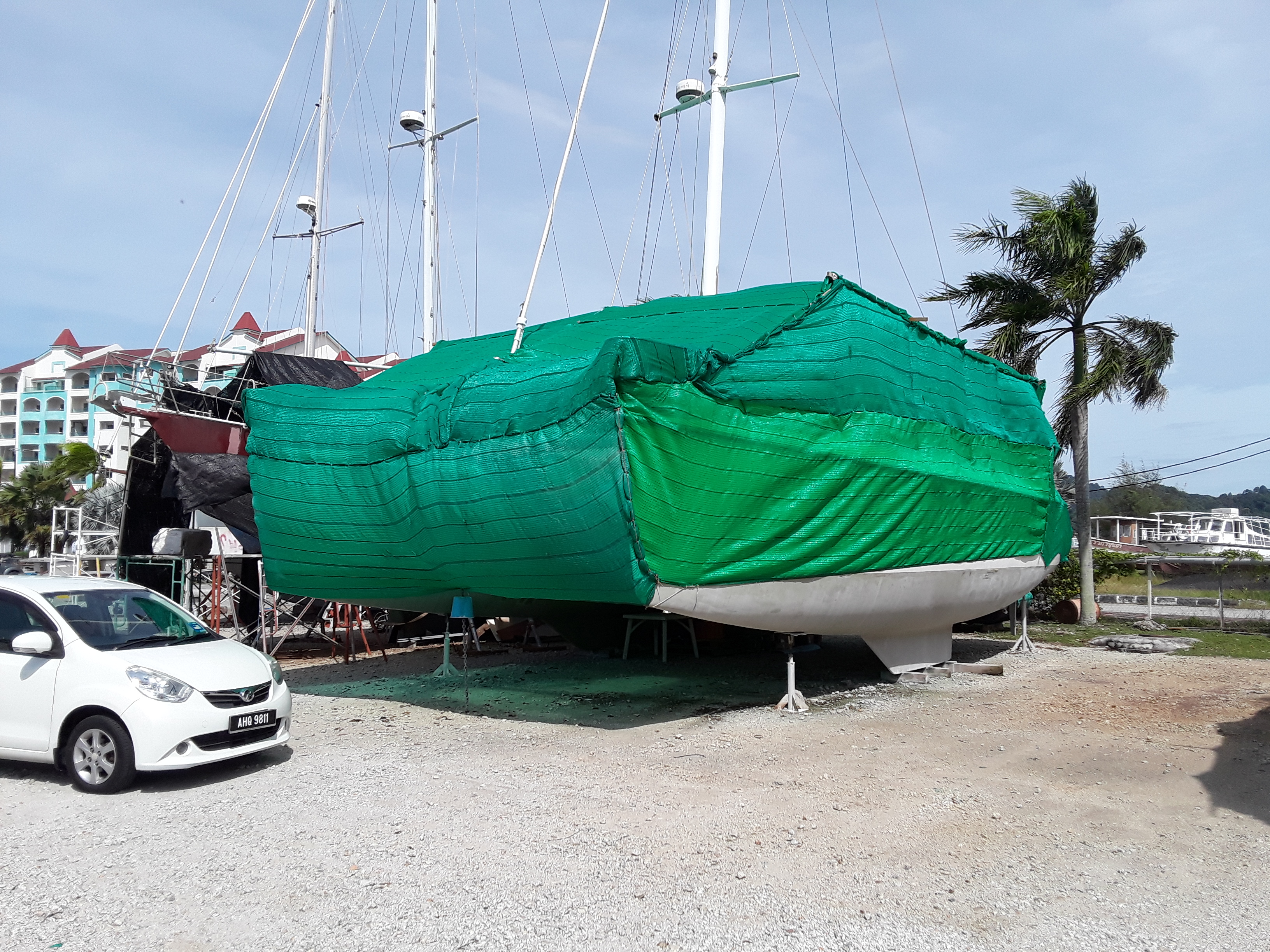
Finally, Tortuguita was wrapped and secure while we take our trip home for the summer.


All wrapped up.  We're finally getting good at this.

Saturday, April 30, 2022

Post Covid Dining

Happy Hour onboard 'Ocean Magic'

As Malaysia re-opened, so did the population of the marina.  Folks had returned to their boats after Covid Cabin Fever and seemed much more social than before.

Unfortunately, like many restaurants worldwide, there were many places that had to shut down.  The same thing happened in Malaysia and some of out favorite places were out of business.

As it turned out, the giant Food Courts turned out to be our go-to places for large group dining. 

The Chinese (WDS) Food Court


The 'Looking Good" Food Court

Lunch at Nipah Beach, Pangkor Island

The Home Curry House moved into the building where Vasantha Bavan was located and kept their old hours of lunch and closed at 6PM.  That pretty much rules out Home Curry for dinner but they are considering staying open until 9PM which would be great.  So we really lost 2 good Indian Restaurants.  

Fortunately our good friends who own a Mom and Pop food cart in the WDS Food Court called Lodge's Indian Food Corner survived Covid.

Dave's Birthday at The German Restaurant
Being one of the remaining Indian places, their little cart ended up tripling their business.  They have lines of delivery guys from GrabFood (similar to Uber Eats in the US) waiting to whisk their deliveries away.

We took a rare day off and went over to Pangkor Island and ate at Nipah Beach.  It was a going away lunch for our Aussie friends Peter and Denise on REVERIE who were heading over to Indonesia and downwind.

The 2 main Western Food joints,  JOOKS 2 and CAPRI, were still in business mostly due to their cruiser and expat clientele. 

Brett's Birthday at Jooks 2
The best Thai food in the area is THAINESE which picked up a new, larger, and renovated corner venue due to the closure of the Malaysian joint that was there.  They will end up doing great.

Our new favorite Indian Food
A great lunch buffet place, D'WARISAN, had just re-opened while we were there and is doing great.  WAN'S Coconut Shakes, the best shakes in town, moved into the same building and is piggy-backing on the buffet.

This was the first time that we were in Malaysia for Ramadan.  Many places just stayed closed for the month and the ones that were open, started serving closer to sunset.  Many tables were pre-reserved for the fasting Muslims so we pretty much avoided those places since we didn't want to eat so late. 

Carlsberg Special Brew 6%
All-in-all, our food choices have become more limited but Covid closures did force us to find new places to go dining.  

Hopefully we will get good full menu Indian and Thai places up in the future.


Ending of a Looking Good Dinner


Friday, April 15, 2022

Tessilmare Rubrails on a Privilege Catamaran

Insert style rubrail

There are 2 types of rubrails.  One kind is a track with a slot that gets an insert. The other is a track that gets a cover over it.  The tracks are screwed to the boat. 
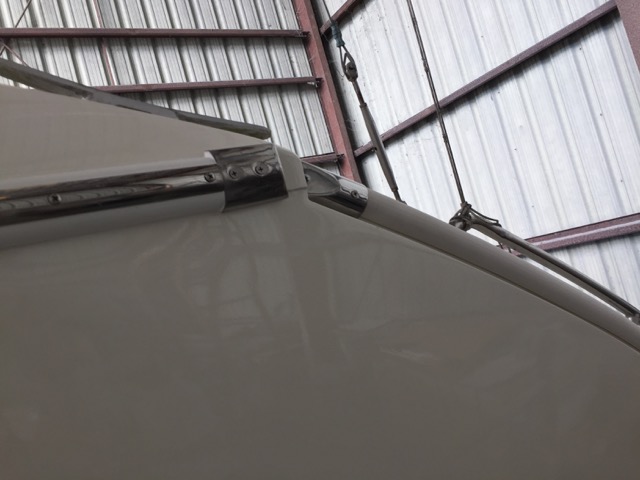


Cover style rubrail by Tessilmare

Tortuguita has rubrails down the sides and around the swim platforms.  Both were in terrible shape and were removed for the gelcoat spraying.  The rubrails that are on the sides have an aluminum track with a plastic insert.  The aluminum was deteriorated, the caulk had failed and dirt and algae were living behind the insert. We replaced these with Vetus EHARO60.

Original swim platform rubrail


Old rubrail removed from groove
The swim platform rubrails were an extruded white rubber that was screwed to the hull through a slot down the center which was then caulked to keep water out.  This is kind of a hybrid design.  These were also in terrible condition.  I researched all options and unless I wanted to have 500’ custom made, I could not find an easy option.

New rubrail has to fit in this groove

The big problem finding a replacement rubrail is that it has to fit into a recessed groove that runs around the perimeter.   


Rubrail on LUNA.  RADIAL 30


Lou on LUNA turned me on to the Tessilmare RADIAL rubrail but the one he used was a little smallish looking (30mm) but it did mount inside the groove easily.

Mounting and thermoforming the track
Well, of course I wanted bigger and didn’t care how hard it was to install so, I bought a sample of the Tessilmare RADIAL 60mm and came up with a plan, sort of.  Nothing ever goes as planned.
Bend the cover to get it on the track
The rubrail mounts on a track by bending the cover and feeding it onto the track.  It’s a neat design and there are many videos on youtube of installations on flat surfaces. 

The problem with installing it into a groove is that the cover spreads out when bending which keeps it from fitting onto the frame.

Mount and trim the cover
 

The first part was to mount and screw the track to the groove so that the cover would fill the groove as much as possible.  I actually installed the rubrail upside-down so that the long edge runs around the upper corner of the swim platform to hide the gap at the top.  The track had to be thermoformed with a heat gun and screwed in place so that the finished product wouldn’t have gaps.

Hold the bottom in the groove and pull the top back to access the screw

Now the fun part was to remove the track and mount the cover on it. 

Then the assembled unit had to be caulked and screwed into the prior drilled holes. 

Some thermoforming was needed on the cover around the compound corners.

After the caulk dried, the edges were taped and caulked.

Each hull took 8 long days to complete with the only real unexpected issue was that the track, being black plastic, expanded 6mm in the heat of the day.  This really caused problems getting the screws back in the correct place during the final remounting.  Nobody said it would be easy.  Especially me.

Finished product


Wednesday, February 23, 2022

2 Year Covid Boat Storage

Shredded sunshade and broken timber
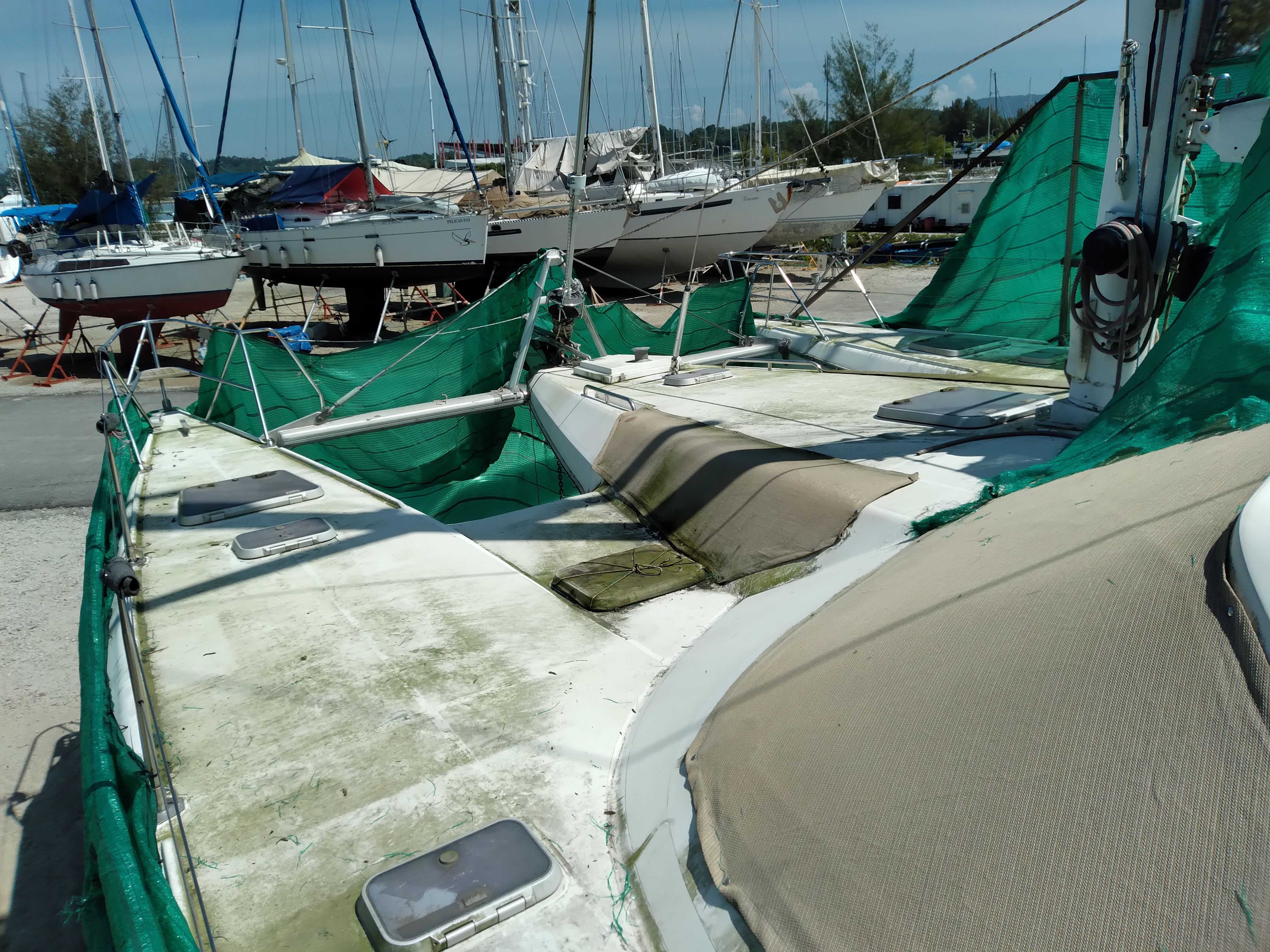
We were back in the US for almost 2 years during Covid, Tortuguita stayed in Malaysia, covered by sunshade exposed to the elements.

We had no idea what to expect when we returned.  

I had built a timber frame on the deck to hold the sunshade.  Would that still be intact?  Would the sunshade be torn to shreds?

Broken timbers at the bow
Would the sunshade be dragging on the ground and make it easier for rodents to infest the boat?

Would there be ants and termites that found there way onboard?

Would monkeys be living aboard?

Worst of all, was rain leaking inside that would allow mold to grow all over?


Well, after 2 years, it really wasn't so bad.  Considering....

Green slime everywhere
 

Yes, the sunshade was shredded in places but not dragging on the ground.

The timbers had rotted or cracked from the high winds but the loose pieces did not cause any chaffing damage.

There were no insects nor rodents living onboard.

There were a few minor leaks but no mold.

Safe in the garage?
The dinghy had been chewed by some boatyard dog but it still held air.

The only mold was on the decks and was the green slime type that grows everywhere in Malaysia.  A little Clorox and pressure washing takes care of it.

The Volvo was parked under the boat well protected.  The tires were kind of flat and the cover was dry rotted but it could have been worse.


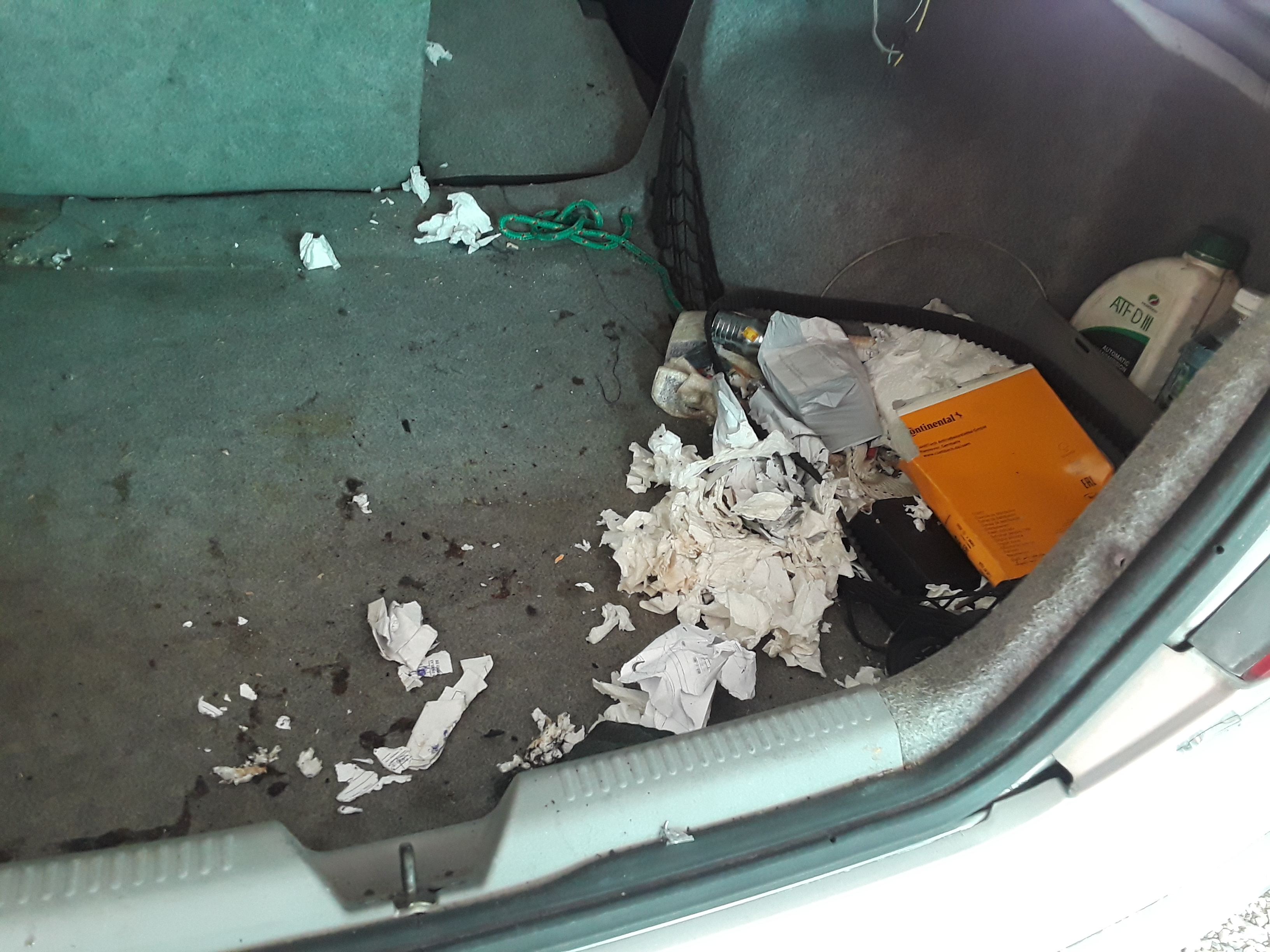
A real Rats Nest
Then again, it was worse as we began poking around.  Rats had been living in the car.  Don't know how they got in or how long they were there but it was not a pretty sight or smell.

If something had to be trashed, it might as well have been the car.  It doesn't owe us anything and I would much rather have a two thousand dollar car destroyed instead of a quarter million dollar yacht.

A worthwhile trade.

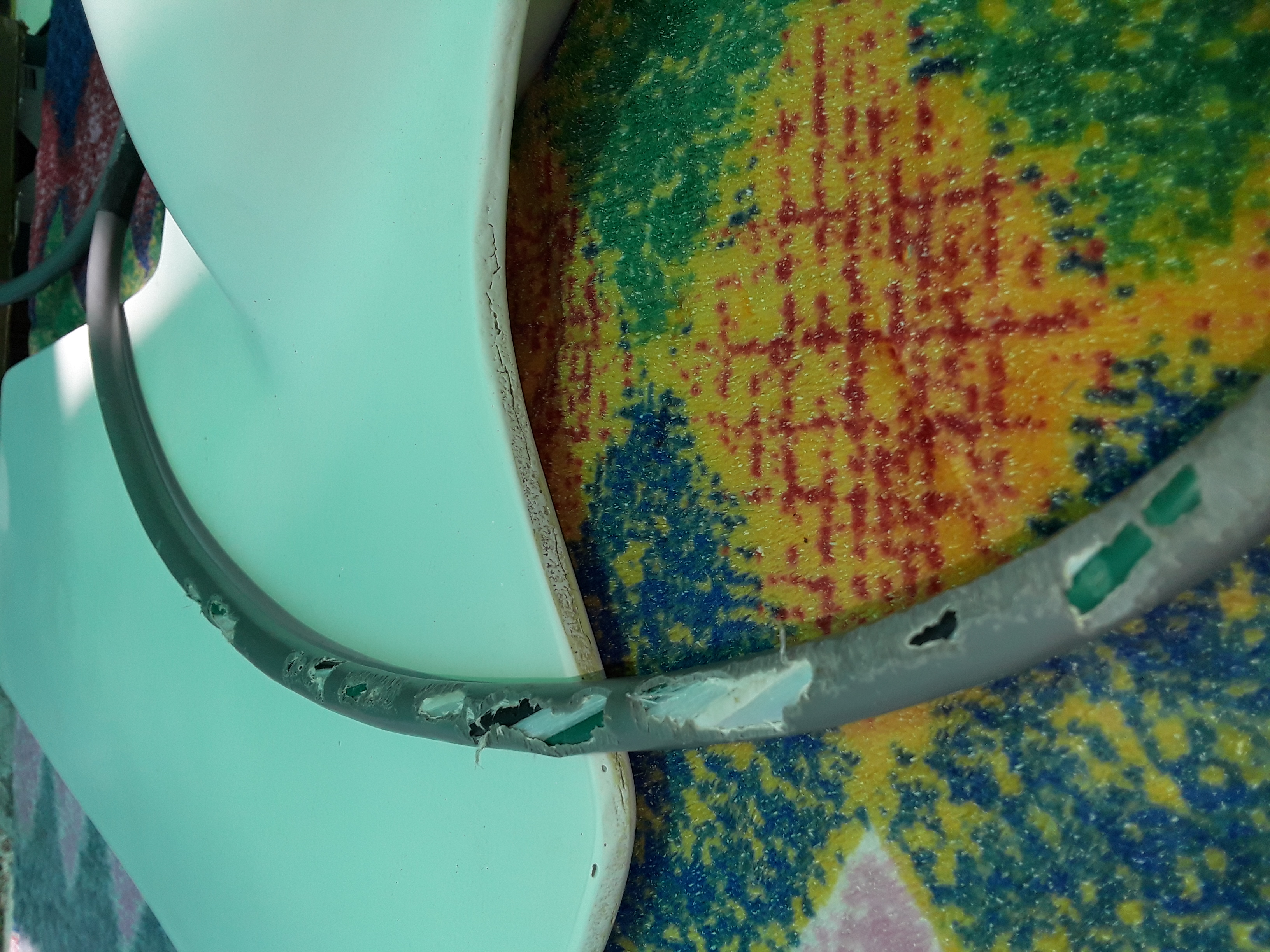
Wire Insulation must taste good